The Transparency Challenge: Priyank Kharge’s Demand for RSS Accountability
RSS must register, pay taxes: Karnataka minister Priyank Kharge writes to Mohan Bhagwat
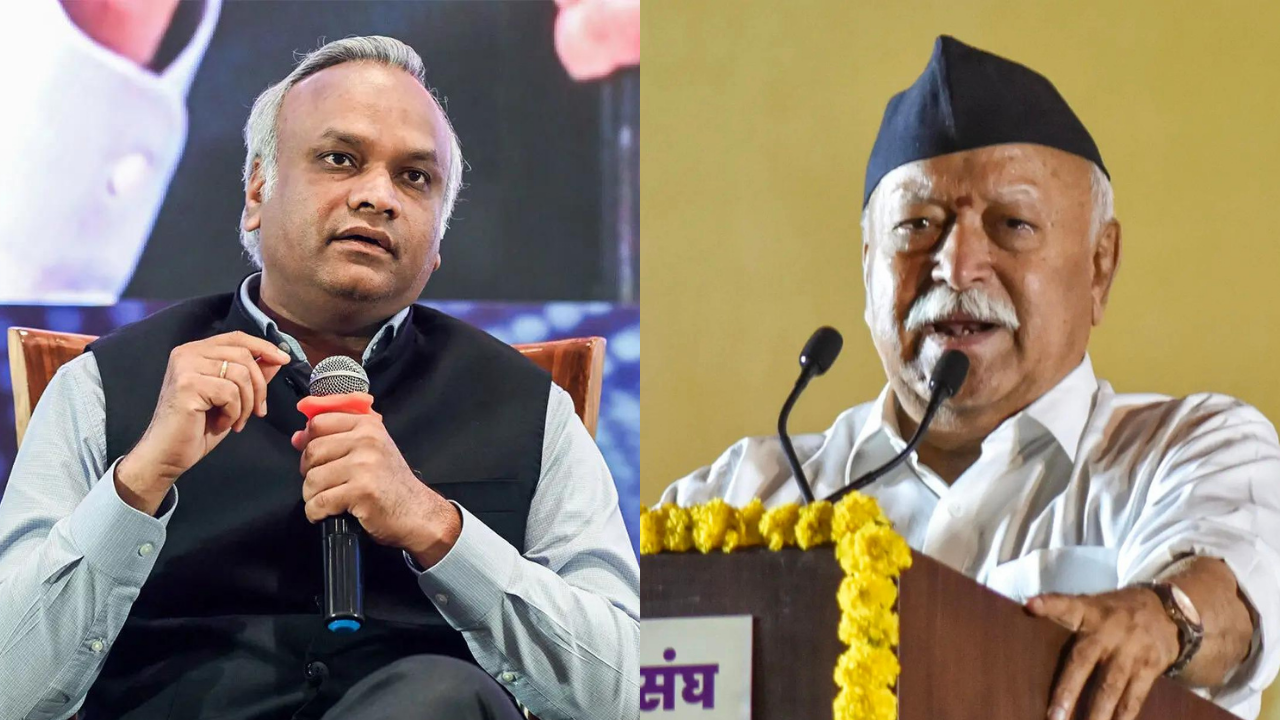
Karnataka minister Priyank Kharge has written to RSS chief Mohan Bhagwat, questioning the legal standing and financial opacity of the century-old organisation.
The sprawling network of the Rashtriya Swayamsevak Sangh (RSS) in Karnataka is no longer just a subject of grassroots mobilisation; it has become the focal point of a sharp administrative query. In a letter to Mohan Bhagwat, Karnataka minister Priyank Kharge has demanded that the organisation pull back the veil on its operations. Citing the Sangh’s own annual reports, the minister pointed to a massive infrastructure: over 4,100 daily shakhas, thousands of weekly meetings, and massive public route marches involving hundreds of thousands of participants.
For Kharge, this scale is exactly why the status quo is untenable. He argues that an entity with such extensive social reach and regular public presence cannot operate as a private, informal arrangement. By asking Bhagwat for clear documentation regarding the RSS’s legal registration, sources of funding, and tax compliance, the minister is effectively challenging the "body of individuals" classification that the organisation has historically relied upon to remain outside the formal regulatory net.
The Question of Compliance
At the heart of this confrontation is the principle of constitutional accountability. Kharge’s missive asserts that if a local NGO or even a small-scale trust must maintain rigorous financial records and audit trails, a nationwide organisation of the RSS’s magnitude should be held to at least the same standard. The minister has explicitly asked for a public disclosure of office-bearers, asset declarations, and the specific legal framework that allows the Sangh to bypass the registration requirements mandated for other civil society groups.
The RSS, for its part, has historically maintained that it does not require formal registration. Bhagwat has previously stated that the organisation functions as a collective of individuals, a position that currently places it in a grey area regarding the stringent transparency laws applied to corporate entities or registered societies. However, Kharge has signaled that the state is not ruling out legislative intervention, suggesting that if the organisation refuses to voluntarily register, the government may eventually move to introduce specific laws to ensure compliance.
Why it matters
This stand-off is more than a bureaucratic spat; it reflects a growing friction between the requirements of a modern, regulated democracy and the traditional, informal structures of influence in India. By focusing on the flow of guru dakshina—the voluntary donations that form the backbone of the Sangh's finances—Kharge is tapping into a broader debate about political and social funding.
The bigger picture here is the intensifying scrutiny of how large, non-corporate entities impact public life. If the Karnataka government proceeds with this line of inquiry, it could set a precedent for how the state monitors the intersection of private ideology and public space. Whether this remains a war of letters or transforms into a protracted legal battle over the nature of "voluntary" organisations in India, the demand for transparency has been firmly placed on the table.
Kabir Sharma writes on culture, technology and everyday life for PoliticalPedia.