The Shadow Over Kerala’s Longest Road Tunnel: Anatomy of a Disaster
Wayanad Landslide Rescue Ops On: What Were Concerns Around Kerala’s Longest Road Tunnel?
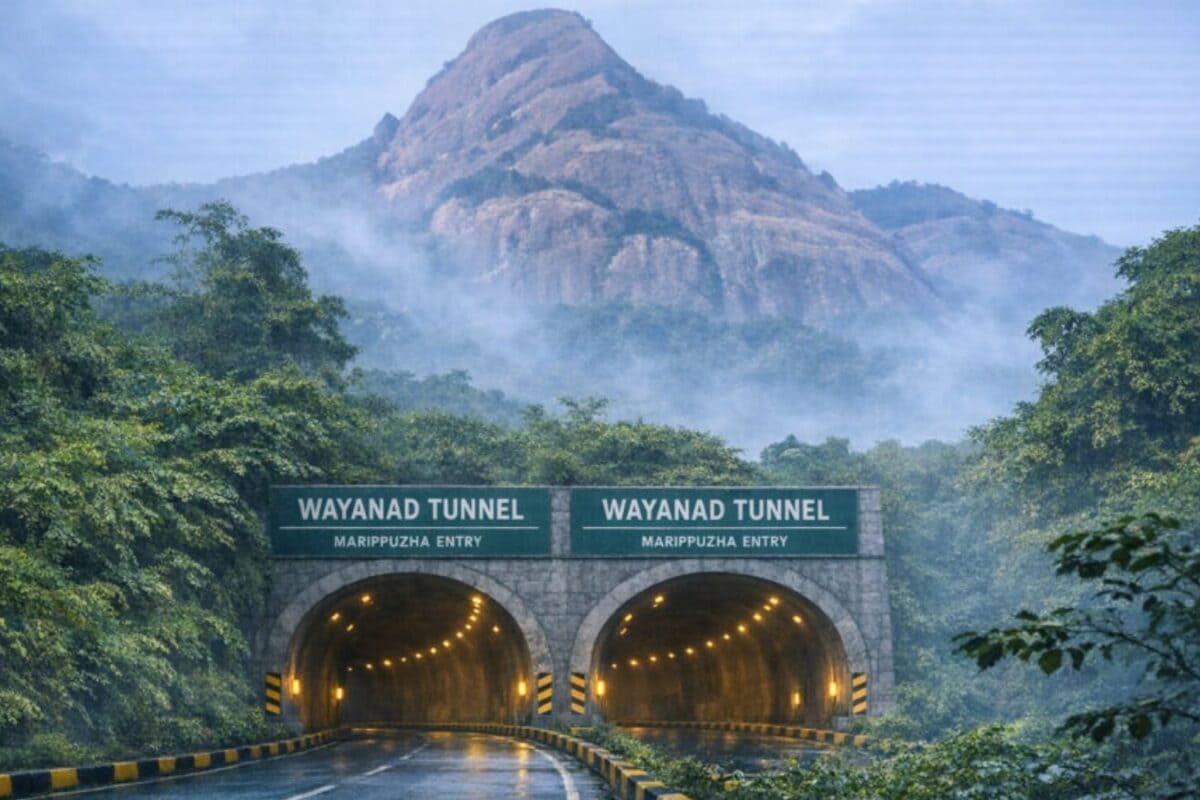
A massive landslide at the Wayanad tunnel project site has left workers buried under debris, turning a flagship infrastructure dream into a site of a desperate search and rescue operation.
The silence of the Anakkampoyil-Kalladi-Meppadi hills was shattered on Tuesday when a catastrophic landslide tore through the construction site of what is set to be Kerala’s longest road tunnel. After 265 mm of relentless rain hammered the region in just 24 hours, the earth simply gave way. A reinforced concrete retaining wall, designed to hold back the hillside, buckled under the pressure, burying worker quarters and heavy machinery in a terrifying sweep of mud and rock.
As the wayanad landslide rescue ops continue, the scene on the ground remains grim. While emergency teams and the NDRF managed to pull five workers from the slush, others remain missing. The site, managed by the Konkan Railway Corporation Limited (KRCL), has been a high-profile project, intended to bridge the distance between regions through a massive twin-tunnel road. Now, the focus is entirely on locating those still trapped beneath the debris.
A Project Under Scrutiny
For months, the tunnel project has been touted as a marvel of engineering, promising to become the third-longest road tunnel in India. Since receiving Supreme Court clearance in April 2026, the excavation work had been moving forward with significant momentum. However, the tragedy has forced an immediate rethink of the safety protocols at the construction site. Even though work had been officially suspended due to the heavy downpour, the sheer scale of the mudslide suggests that the natural volatility of the terrain may have been underestimated.
The questions surrounding the incident are growing louder. Critics and local observers are asking: what were concerns around the structural integrity of these hill-cuts during the monsoon? The incident highlights the inherent fragility of executing large-scale engineering feats in ecologically sensitive zones. When a project of this magnitude meets the ferocity of a Kerala monsoon, the thin line between progress and catastrophe becomes painfully visible.
The Bigger Picture
This tragedy serves as a sobering reminder of the hazards involved in pushing massive infrastructure projects through unstable, high-rainfall mountainous regions. The "man-made" tag attached to this disaster by some officials isn't just a political soundbite; it reflects a growing anxiety about how we design for a changing climate. As road and tunnel projects gain steam across the Western Ghats, the reliance on concrete barriers to "tame" the terrain is being tested by increasingly extreme weather events.
Moving forward, the state faces a difficult balancing act. There is a palpable need for better connectivity, but the cost of achieving it in such sensitive topographies is rising—both in terms of financial investment and human lives. Unless engineering standards are fundamentally recalibrated to account for unprecedented rainfall patterns, the blueprint for India’s infrastructure expansion may need a radical update to prevent further tragedies at sites like these.
Kabir Sharma writes on culture, technology and everyday life for PoliticalPedia.