INDIA bloc leaders gather in Delhi to recalibrate strategy against Modi government
INDIA bloc meeting: Opposition leaders seek unity, deliberate to redraw strategy
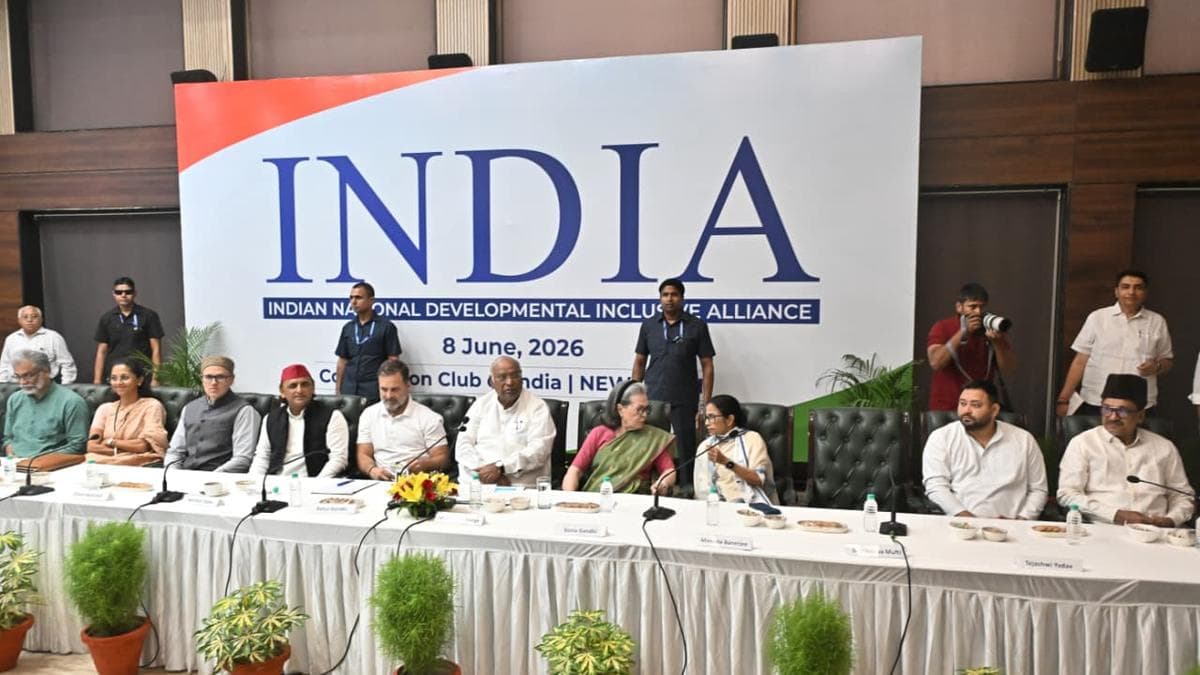
Top opposition brass met in the capital on June 8 to consolidate their ranks and challenge the BJP’s narrative on governance and institutional integrity.
The corridors of power in New Delhi saw a flurry of activity on June 8, 2026, as top leaders of the INDIA bloc gathered to chart a collective path forward. With the post-election landscape shifting, the opposition leaders are looking to convert their legislative coordination into a cohesive, long-term political strategy. The meeting served as a high-stakes arena for a coalition that is clearly eager to shed the tag of a reactive force and emerge as a proactive challenger to the Modi government.
The attendance list underscored the gravity of the exercise. Congress chairperson Sonia Gandhi, Leader of the Opposition in the Lok Sabha Rahul Gandhi, and Congress president Mallikarjun Kharge were present alongside heavyweights like TMC chief Mamata Banerjee, Samajwadi Party chief Akhilesh Yadav, and J&K CM Omar Abdullah. While Uddhav Thackeray joined via video link, his aide Sanjay Raut was quick to affirm that the Shiv Sena (UBT) remains a fully committed partner, intent on fighting the "grave challenges" facing the nation with an eye on the 2029 general elections.
Building on legislative synergy
For the INDIA bloc, the roadmap to unity is rooted in recent legislative friction. In his opening remarks, Mallikarjun Kharge highlighted the April 17, 2026, victory in the Lok Sabha as a blueprint for the future. By successfully blocking what the coalition termed "malicious bills" regarding delimitation, the opposition proved that they could act as a single, effective unit against the treasury benches.
"We must now strengthen and carry forward that same spirit," Kharge said, urging the alliance to move past internal friction. The Congress president’s address was wide-ranging, touching upon a perceived assault on the Constitution and the alleged weaponisation of central probe agencies to bully political opponents. He also turned his guns on the government’s economic record, citing sluggish investment and a crisis in the examination system as evidence of "complete mismanagement."
Why it matters
This meeting is more than just a routine gathering; it is an attempt to institutionalise the "spirit of April 17." For the INDIA bloc, the challenge lies in sustaining this momentum when they aren't facing a direct vote on the floor of the Sabha. The coalition is clearly betting that a unified front—one that pivots from parliamentary skirmishes to sustained agitation on economic and social issues—is their best chance at staying relevant in the national discourse. If they can iron out the internal differences that often plague such broad-tent alliances, they hope to present a formidable, credible alternative to the current establishment.
National Affairs Desk at PoliticalPedia covers government & policy for an Indian audience in English and Hindi.