From Buffett’s Patience to Musk’s Velocity: The New Math of Global Wealth
Musk tops Buffett in a day: 7 stats on this week’s number platter
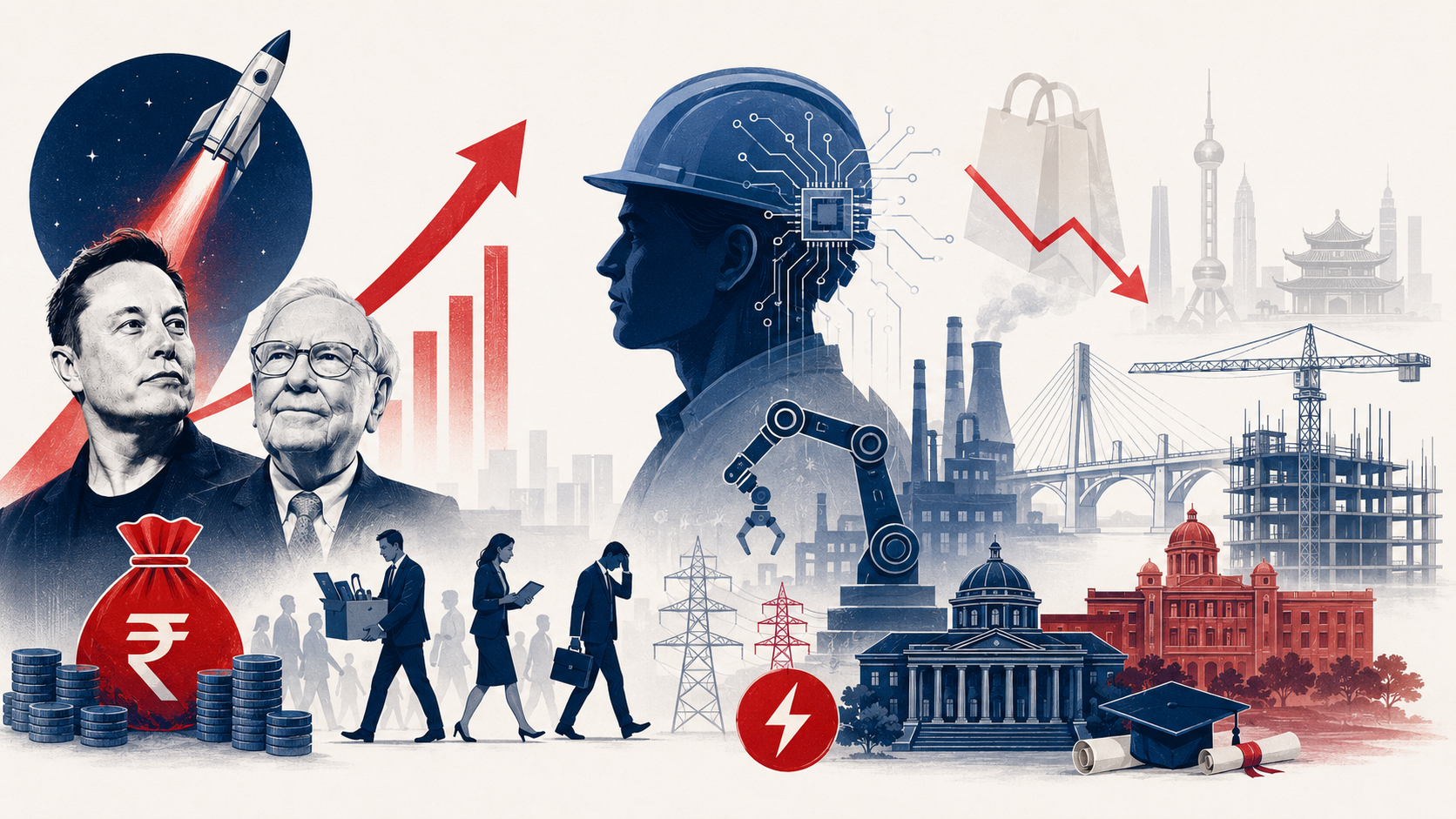
A single day’s surge in SpaceX valuations reveals a widening gap between traditional value investing and the high-stakes world of frontier capital.
The numbers from the past week feel less like standard financial reporting and more like a glitch in the simulation. When Elon Musk saw his net worth climb by $164.8 billion in a single day—a figure that eclipsed Warren Buffett’s entire $146.4 billion fortune—the chasm between two distinct eras of capital became impossible to ignore. Triggered by a 66% jump in SpaceX stock over three days, this movement isn't just a win for the world’s first trillionaire; it is a signal that the market’s appetite for the future has hit a fever pitch.
The Collision of Two Philosophies
For decades, the gospel of the market was written by the likes of Buffett. It was a philosophy of patient capital, built on the quiet magic of compounding and the belief that if you buy well and wait long, the returns will follow. That foundation is now being challenged by what we might call "frontier capital." This is the era of rockets, private space exploration, and deep tech, where valuations are priced not on today’s balance sheets, but on the assumption that tomorrow’s technology has already arrived. The $18.4 billion difference between Musk’s single-day gain and the entirety of Buffett’s life work is the clearest evidence yet of this shift.
The China Puzzle
While the markets chase the Musk-led rally, the real economy presents a more sobering picture. China, a central pillar of global manufacturing, is currently caught in a two-speed struggle. While industrial output climbed 4.5% year-on-year in May, fixed-asset investment dropped 4.1% over the first five months of the year. Most tellingly, retail sales slid 0.6% in May—the first decline since late 2022. It isn't a collapse, but it is a clear warning that Chinese consumers have yet to mirror the optimism seen in high-tech stock valuations.
Why it matters
The divergence between the exuberance of tech-heavy markets and the cooling of consumer confidence in major economies like China suggests a fragile global equilibrium. When wealth can be generated at such velocity—where a single company’s market debut outpaces the accumulated wealth of an investment legend—it speaks to a market that is disconnected from traditional economic gravity. Investors are betting on a future of AI and space-age innovation, but if the real-world manufacturing and consumption cycles in hubs like China continue to wobble, that "simulation" may eventually have to reconcile with reality. We are watching a high-stakes gamble on the future, one that prizes speed above all else.
Arjun Mehta reports on government, policy and Parliament for PoliticalPedia, in English and Hindi.