Contrasting Responses: Delhi Remains Calm While Haryana Deploys Water Cannons Against Protesters
Two protests, two responses: Delhi stays calm as Haryana turns water cannons on youth Congress demonstrators
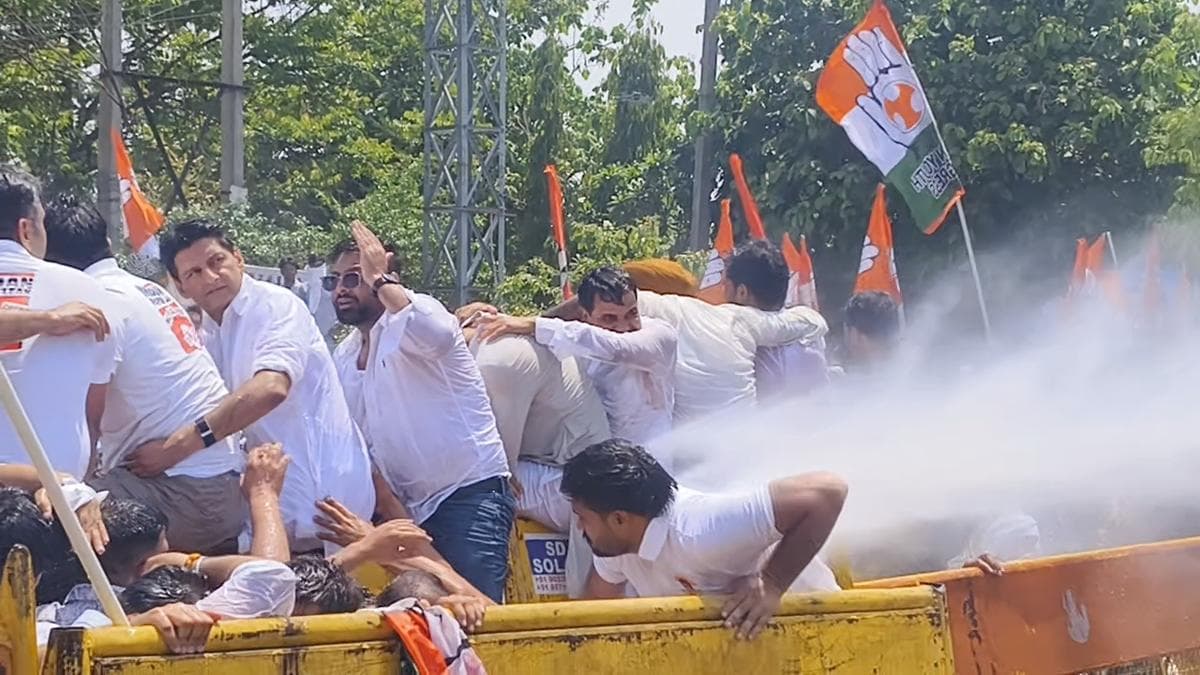
While the national capital saw a restrained security approach during Saturday’s demonstrations, protesters in Kurukshetra faced a forceful dispersal as tensions escalate over examination irregularities.
The political landscape heated up on Saturday as two distinct demonstrations took place across Delhi and Haryana, both centered on alleged irregularities in recruitment and examination processes. While both events targeted the government over the same grievances—specifically demanding the resignation of Union Education Minister Dharmendra Pradhan—the state-level authorities adopted vastly different security postures. In the capital, the Cockroach Janata Party (CJP) held a protest that saw a remarkably restrained response from security personnel, contrasting sharply with the aggressive tactics employed by police in Haryana.
A Tale of Two Responses
In Kurukshetra, the scene was markedly more volatile. Congress party workers, led by Lok Sabha MP Deepender Hooda, organized a march aimed at the residence of Haryana Chief Minister Nayab Singh Saini to demand accountability for the NEET paper leak and ongoing issues with CBSE examinations. As the crowd attempted to gherao the residence, local police deployed water cannons to disperse the demonstrators. This pushback highlights the rising friction between the opposition and the state administration, with Mr. Hooda framing the struggle as a long-term fight that will move from the streets to the Parliament.
The disparity in how these two demonstrations were managed has sparked a fresh round of political finger-pointing. Srivatsa Y. B., a close aide to the Leader of the Opposition, Rahul Gandhi, used social media to critique the optics of the situation. He suggested that the CJP’s protest in Delhi was essentially a performative act, contrasting it with the broader, more aggressive movement being spearheaded by the National Student Union of India (NSUI) across the country.
Demands for Accountability
At the heart of the agitation is a widespread frustration over what protesters describe as a systemic failure of the examination process. Addressing the crowd in Kurukshetra, Mr. Hooda alleged that "paper-leak mafias" have been operating under the patronage of the BJP government for over a decade. He cited the state's high unemployment rates and the prevalence of drug abuse as primary drivers for the youth’s anger, asserting that the resignation of Minister Dharmendra Pradhan is a non-negotiable demand for the party.
The volatility surrounding these recruitment exams reflects a growing crisis of confidence among India’s student population. With allegations of irregularities in high-stakes tests becoming a recurring theme, the political stakes for the Union Education Ministry have risen significantly. Mr. Hooda has already signaled that this is not an isolated event, announcing that the next phase of the demonstration will be held in Panipat on June 12.
As the government grapples with these protests, the focus remains on whether these allegations of institutional malpractice will lead to substantive policy changes or continue to trigger further civil unrest. For now, the divide in the police response—restraint in the capital versus force in the state—serves as a barometer for how seriously authorities are viewing the political mobilization against the current administration.
The PoliticalPedia Editorial Desk brings verified, sourced political news and analysis from across India.