Beyond the Shutters: Why TN’s Liquor Policy Remains a Revolving Door
Shut but open | T.N.’s closure of liquor shops
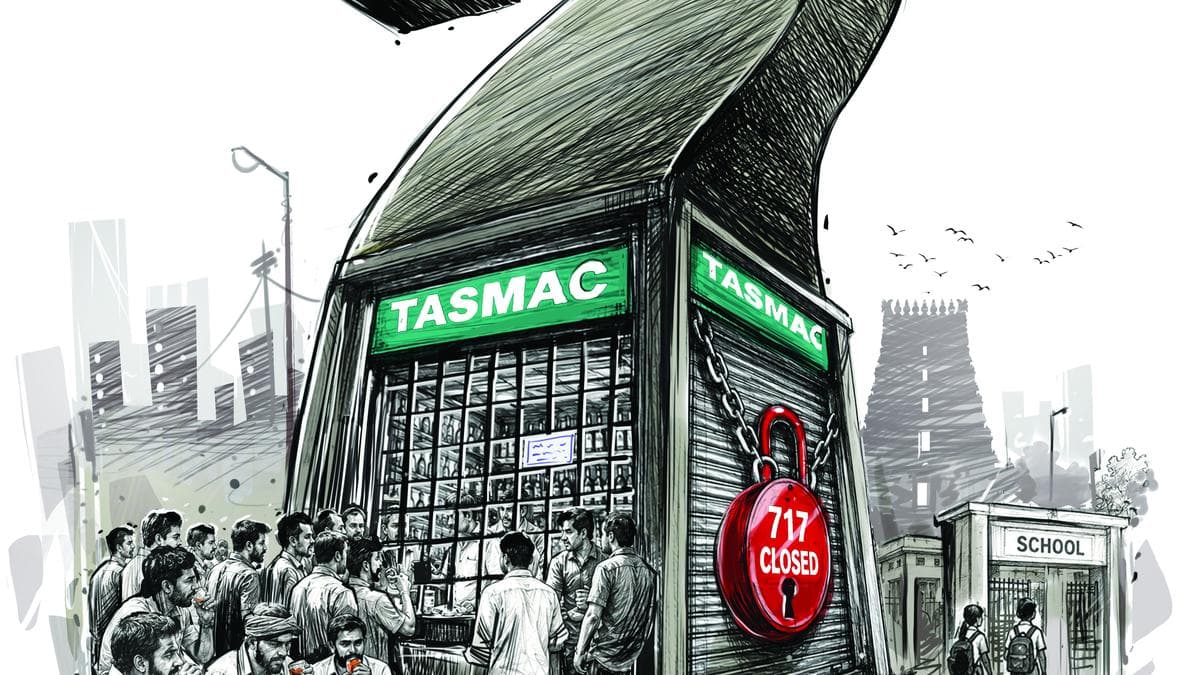
While the state government has closed hundreds of Tasmac outlets near schools and temples, residents argue that the move is a cosmetic fix that fails to address public nuisance.
The landscape of retail alcohol sales in Tamil Nadu has undergone a visible shift over the past month. Following a directive from Chief Minister C. Joseph Vijay on May 12, exactly 717 liquor shops situated in the proximity of schools and places of worship have been shuttered. For a state that has long grappled with the political sensitivity of alcohol prohibition, this latest drive represents another chapter in a familiar script. Since the tenure of J. Jayalalithaa in 2016, successive administrations have periodically announced the closure of hundreds of outlets—a cycle that observers suggest is as much about managing public sentiment as it is about policy reform.
The Geography of Migration
Despite the disappearance of these specific storefronts, the ground reality for many residents remains largely unchanged. Field observations across various districts reveal that when a local outlet is closed, customers simply migrate to the next nearest Tasmac shop. This "migration effect" means that while a specific street may see its shutters pulled down, the overall volume of business and the frequency of public drunken nuisance in residential areas have not seen a corresponding decline. For the average resident, the transition from an "open" to a "closed" status for a neighbourhood shop is often merely a change in the commute for the consumer rather than a genuine reduction in access.
A Cycle of Symbolic Closures
The current administration’s move follows a long-standing pattern of incremental prohibition. In 2017, Edappadi K. Palaniswami oversaw the closure of 500 shops, and as recently as 2023, then-Minister V. Senthil Balaji reaffirmed the government's commitment to reducing the retail footprint of the state-run liquor monopoly. Industry analysts argue that these repeated, phased closures are a tactical necessity for political parties seeking to balance the state’s heavy reliance on liquor revenue against the vocal demands of voters who want these outlets removed from residential zones.
Lingering Demands
In cities like Chennai, the frustration is palpable. In the Velachery neighbourhood, for instance, residents of Balakrishna Nagar continue to lobby for the removal of Tasmac Shop No. 928. Despite the recent wave of closures, this specific outlet remains a point of contention, as it sits on a critical transit artery serving multiple residential complexes and the local MRTS station. Critics of the current policy point out that until the government adopts a more transparent and comprehensive zoning strategy, residents will continue to feel that their concerns are being met with half-measures.
While the debate over alcohol access in India often draws comparisons to how other regions manage holiday closures—ranging from dry days during Christmas or Easter to localized restrictions—the Tamil Nadu model remains unique in its reliance on a state-run retail chain. As the state continues to navigate this complex balance, the question remains whether the government will eventually move toward a more structural overhaul, or if citizens will continue to view these closures as little more than a temporary shift in the local map.
The PoliticalPedia Editorial Desk brings verified, sourced political news and analysis from across India.