After Five Decades, 100 Hours of Radio Observations Crack a Year-Long Black Hole Mystery
100 Hours of Radio Observations Crack a 50-Year Black Hole Mystery
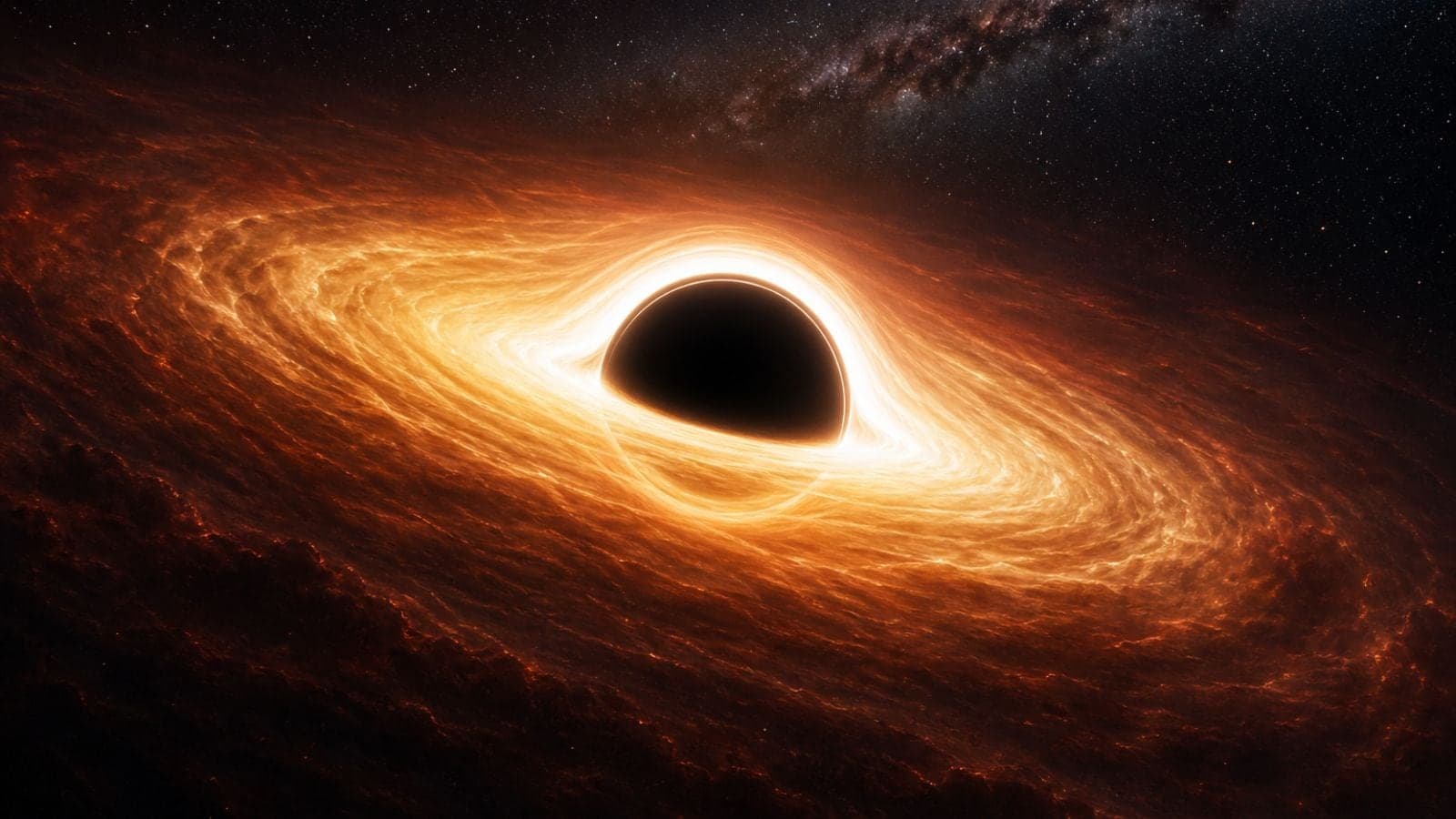
Astronomers have finally detected a gentle breeze emanating from Sagittarius A, the supermassive black hole at the heart of our galaxy, resolving a puzzle that has gripped the scientific community for 50 years.*
For half a century, Sagittarius A* has been the ultimate cosmic enigma. Sitting at the centre of the Milky Way, obscured by dense veils of interstellar dust and gas, the supermassive black hole has kept its secrets well hidden. Now, a team led by Northwestern University has finally peered through that haze. By dedicating 100 hours of radio observations using the Atacama Large Millimetre/Submillimeter Array (ALMA) in Chile, researchers have uncovered clear evidence of a wind pushing away from the black hole.
The Gentle Breeze of a Quiet Giant
The findings, published in Astrophysical Journal Letters, mark a shift in how we understand black holes. While we often associate these gravitational behemoths with violent, high-energy outbursts, Sagittarius A* is currently in a "quiet" state. Lead astrophysicist Lena Murchikova notes that while we have long theorized about the powerful gales emitted by active black holes—capable of clearing entire galaxies of material—we had never before seen the "gentle breeze" that likely characterizes a black hole’s everyday existence.
To capture this, researchers Mark Gorski and Murchikova spent five years analysing data from the ALMA telescopes. The radio observations revealed a cone-shaped path originating from the black hole, visibly devoid of cold carbon monoxide gas. This void is the smoking gun: it is carved out by hot winds flowing outward as the black hole consumes nearby matter. The imaging was so precise that it provided a view 80 times sharper than previous attempts to map the neighbourhood of the galactic centre.
Why it Matters: Shaping the Galaxy
This discovery is more than just an academic milestone. The presence of these winds acts as a cosmic regulator. By pushing gas away, these winds directly interfere with star formation, which requires compressed dust clouds to ignite. In essence, the "breeze" from Sagittarius A* limits how much the black hole itself can grow while simultaneously tempering the birth rate of new stars in its vicinity.
For years, the scientific community struggled to confirm these winds because Sagittarius A* does not behave like the loud, explosive black holes seen elsewhere in the universe. Identifying this quiet outflow proves that even in a dormant phase, a black hole is a dynamic architect, constantly sculpting the environment of its home galaxy. This 50-year mystery is finally resolved, but it opens a new chapter in understanding how the Milky Way maintains its delicate balance.
Business Desk at PoliticalPedia covers economy & markets for an Indian audience in English and Hindi.