The vanishing Alps: Why Swiss glaciers are hitting a breaking point
Swiss glaciers shrink as climate crisis fuels extreme heat across Europe
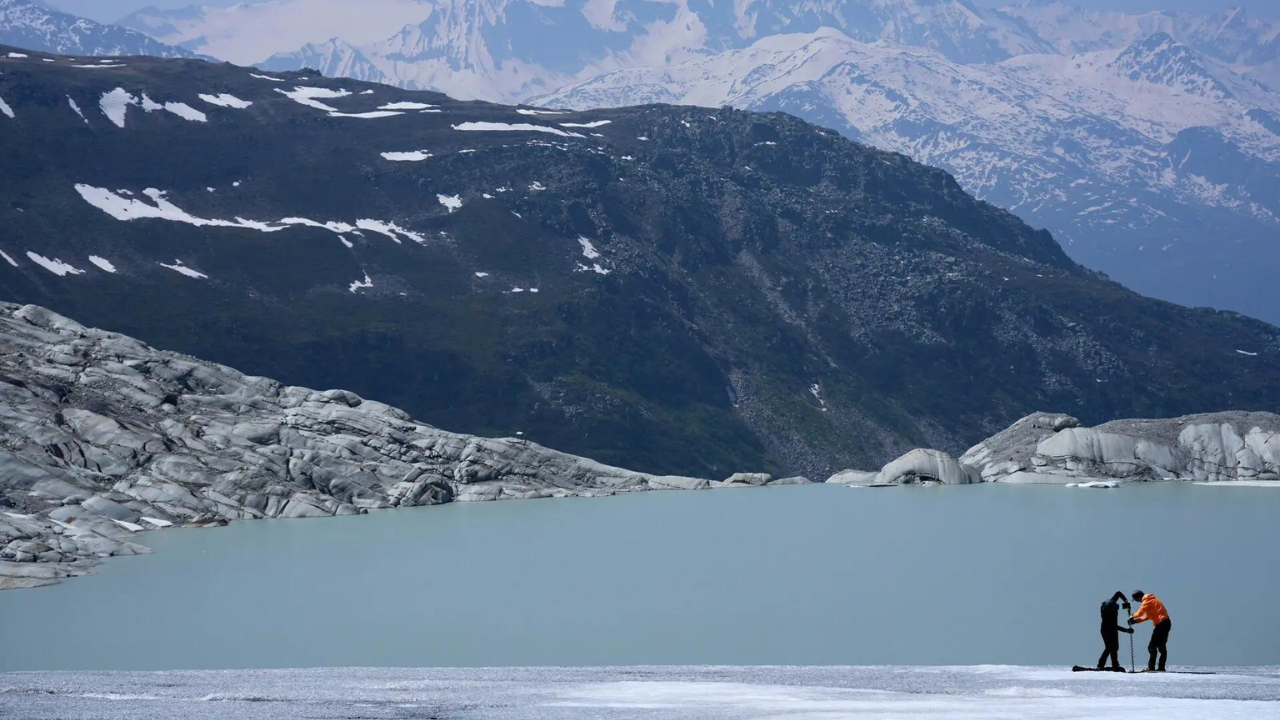
As record heatwaves and thinning snow cover push Switzerland’s icy giants to the brink, the physical and economic landscape of Europe is being fundamentally reshaped.
Standing on the Rhone Glacier, the crunch of slushy ice underfoot isn't just a sign of summer—it’s a warning. Matthias Huss, who leads the glacier monitoring network GLAMOS, has spent his season documenting a grim reality: the ice is retreating at an accelerating, often terrifying, pace. This year alone, Swiss glaciers have lost 3% of their total volume, marking the fourth-largest annual decline on record. When you look at the last decade, the scale of the loss is staggering. Since 2015, Switzerland—which holds the largest concentration of glaciers in Europe—has seen its frozen reserves shrink by a full quarter.
A new, dangerous normal
The culprit is a relentless combination of environmental stressors. A lacklustre winter failed to provide the protective blanket of snow needed to shield the ice from the intensity of the summer sun. When that thin layer vanished early, it exposed darker, older ice that absorbs more solar radiation, triggering a feedback loop of rapid melting. By June, the heat was already punishing; some regions reported ice thickness dropping by a full metre in just over a week. For experts like Huss, the concern isn't just the record-breaking nature of one year, but that these "negative years" are becoming the new baseline.
The consequences are moving from abstract climate data to immediate, tangible threats. In May, the village of Blatten was largely buried under a mass of rock and ice after the Birch Glacier—destabilised by shifting conditions—broke away from the mountainside. While the village had been evacuated, the event served as a violent reminder that as the climate warms at twice the global average in this region, the very geography of the Alps is becoming unstable.
Why it matters
The implications extend far beyond the mountaineering trails of the Swiss Alps. These glaciers act as the "water towers" of Europe, feeding the continent’s most vital river systems. As the ice disappears, the predictable flow of water required for hydropower, agriculture, and cross-border transport is becoming increasingly volatile. When the glaciers are gone, the summer water security for millions of people across the continent will face an unprecedented crisis.
What we are witnessing is an irreversible transformation. While cutting global carbon emissions to zero within the next three decades might save about one-third of the remaining ice, the rest is effectively committed to history. We are no longer talking about preventing a change; we are talking about managing a collapse. For a nation synonymous with its peaks, the disappearance of over 1,100 glaciers since the 1970s is not just an ecological loss—it is a structural shift in the European economy and landscape that the continent is only beginning to account for.
Priya Nair covers parties, elections and the business of power for PoliticalPedia.