From Ulaanbaatar to Global Peacekeeping: Jat Regiment Joins Khaan Quest 2026
Jat Regiment troops participate in an exercise with soldiers from 18 countries in Mongolia
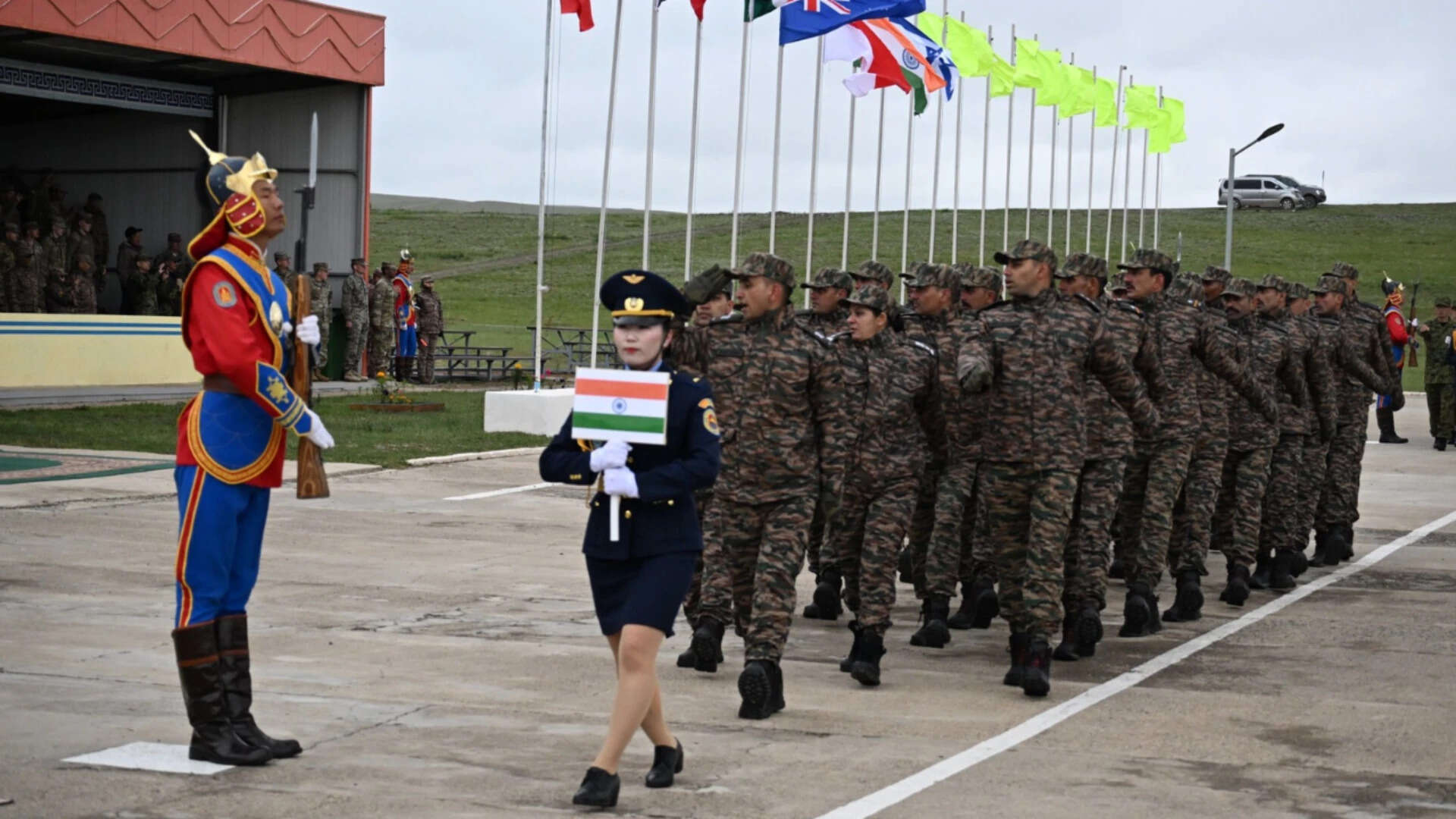
Indian Army troops are currently training alongside 18 nations in Mongolia to sharpen tactical skills for future United Nations peacekeeping deployments.
The rugged terrain of the Five Hills Training Area in Ulaanbaatar is currently a melting pot of global military expertise. A 40-member contingent from the Jat Regiment, supported by specialized personnel from other arms of the Indian Army, has officially joined Exercise Khaan Quest 2026. This year’s edition brings together soldiers from 18 nations, including the United States, Germany, and South Korea, to refine the mechanics of international peace support operations.
Sharpening Tactical Readiness
Originating in 2003 as a bilateral drill between the US and Mongolia, Khaan Quest has evolved over two decades into a vital multilateral platform. For the Indian troops on the ground, the focus is strictly operational. Under the framework of Chapter VII of the UN Charter, the exercise pushes participating forces to synchronize their responses in high-pressure scenarios.
The training curriculum is comprehensive: troops are running drills that mirror the volatility of real-world missions, from establishing checkpoints and conducting cordon-and-search operations to managing civilian evacuations in hostile zones. The contingent is also practicing critical life-saving skills, including combat first aid, casualty evacuation, and countering improvised explosive devices (IEDs).
A Diplomatic and Strategic Convergence
The timing of the exercise is notable. It coincides with External Affairs Minister S. Jaishankar’s diplomatic visit to Mongolia, highlighting the deepening strategic partnership between New Delhi and Ulaanbaatar. Beyond the tactical training, the exercise serves as a soft-power bridge, allowing the Indian Army to share best practices and build interoperability with diverse global militaries. As US Ambassador to Mongolia Richard L. Buangan noted, the objective is to ensure that when crises hit, multinational partners can function as a cohesive unit rather than a collection of disparate forces.
The Bigger Picture: Why It Matters
For India, participation in Khaan Quest is more than just a training rotation; it is an extension of its long-standing commitment to global stability. With over 5,000 Indian peacekeepers currently deployed across nine active UN missions, the country remains one of the world's most significant contributors to international peace efforts.
The pattern here is clear: by engaging in multilateral drills like Khaan Quest, the Indian Army is signaling its readiness to operate in increasingly complex geopolitical environments. Whether it is protecting civilians or supporting ceasefire agreements in volatile regions, the experience gained in the Mongolian hills directly feeds into India's long-term role as a "net security provider" in the international arena. As these missions grow more hazardous, the ability to integrate seamlessly with global partners has become a non-negotiable requirement for the modern soldier.
Arjun Mehta reports on government, policy and Parliament for PoliticalPedia, in English and Hindi.