From Satire to Streets: 'Cockroaches on the Ground' as Dipke Posts Jantar Mantar Protest Visuals
‘Cockroaches On The Ground’: Dipke Posts Jantar Mantar Protest Visuals
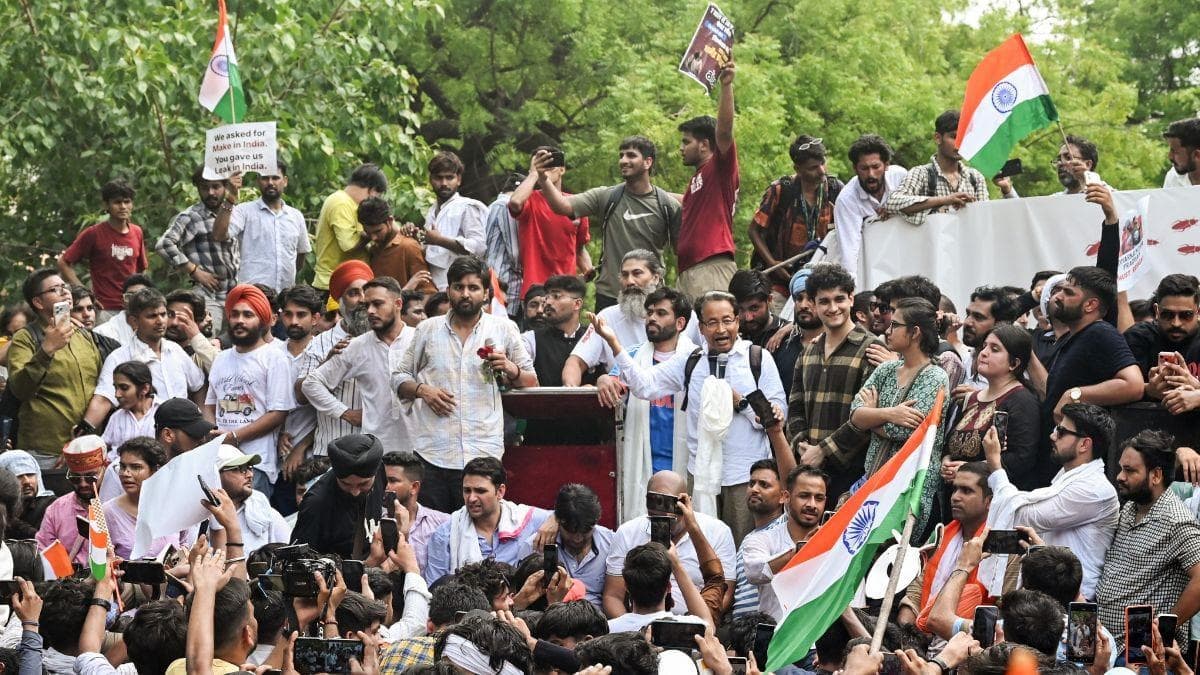
The newly formed Cockroach Janata Party staged its first physical demonstration in the national capital, demanding accountability for examination irregularities and the resignation of the Union Education Minister.
The heart of the national capital turned into a focal point of student unrest on Saturday as the Cockroach Janata Party (CJP) held its inaugural street protest at Jantar Mantar. Following a social media surge, the outfit’s founder, Abhijeet Dipke, who flew into Delhi from the United States, led the demonstration against the backdrop of the NEET paper leak controversy and alleged irregularities in CBSE Class 12 results. Asserting that the movement had transcended its digital roots, Dipke shared evocative protest visuals online with the caption, “They said cockroaches will never come on the ground…”
A Movement Born from Judicial Remarks
The origins of the CJP are rooted in political satire. The group was conceived as a direct response to comments made by Chief Justice of India Surya Kant during a recent court hearing, in which certain individuals were described as "cockroaches" and "parasites." By adopting the moniker, the founders aimed to reclaim the derogatory label, transforming it into a badge of identity for those critical of the status quo. What began as a viral online phenomenon faced its first physical test in Delhi, with the group issuing a strict code of conduct for participants: avoid violence, carry books, and offer flowers to police personnel.
High Stakes and Heavy Security
The demonstration drew a significant police response, with reports indicating that security was tightened significantly, including the deployment of approximately 1,000 security personnel to manage the gathering. While some observers on social media questioned the crowd size, others highlighted the presence of prominent voices, including climate activist Sonam Wangchuk, who stood in solidarity with the protesters. The atmosphere at Jantar Mantar was charged, with attendees—a mix of students, competitive exam aspirants, and concerned parents—voicing deep-seated frustrations regarding the digitization of the education sector and the perceived lack of fairness in national testing systems.
The Ultimatum for the Education Minister
Beyond the immediate protest, the agenda remains focused on high-level accountability. Dipke issued a sharp ultimatum, declaring that if Union Education Minister Dharmendra Pradhan does not step down by 5:00 pm on Saturday, the organization plans to escalate its movement into a nationwide agitation. Wangchuk further amplified the stakes, vowing to undertake a 42-day hunger strike should the authorities move to arrest Dipke or other key members of the group. As the protest concluded, the CJP’s challenge to the government remains clear: they are no longer satisfied with digital discourse and are pressing for systemic changes to India’s beleaguered examination infrastructure.
The PoliticalPedia Editorial Desk brings verified, sourced political news and analysis from across India.