Escalation in Kyiv: Russia’s Massive Aerial Assault Overshadows Upcoming NATO Summit
Russia strikes Kyiv with 68 missiles, 351 drones; 11 killed ahead of Nato summit
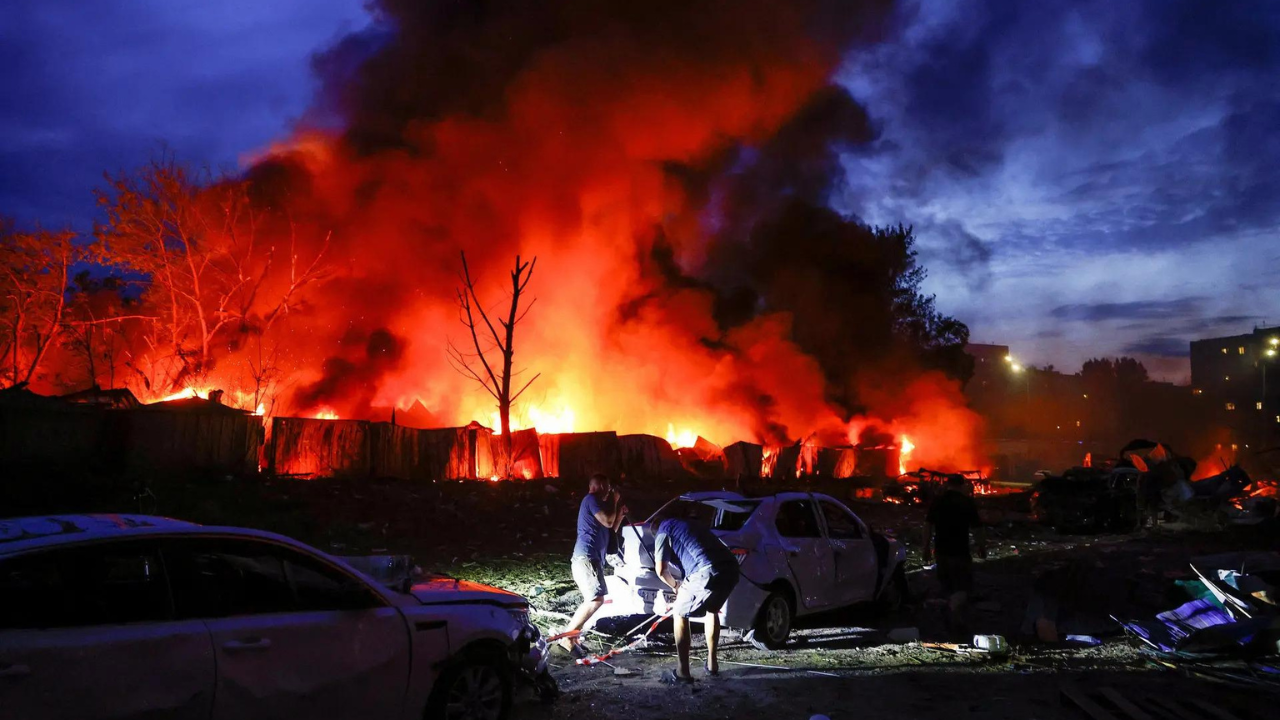
At least 11 lives lost as Moscow launches a complex barrage of missiles and drones, intensifying pressure on Western allies to bolster Ukraine’s air defences.
The morning air in Kyiv, usually thick with the hum of a waking city, was shattered by the roar of explosions as Russia launched a coordinated, high-intensity aerial offensive. Over 68 missiles and 351 drones were unleashed in a strike that left at least 11 people dead and scores more injured. In the historic Podilskyi district, the scene was one of devastation; a nine-storey residential block stood gutted, its upper floors shorn away by the impact. Emergency crews are currently combing through the rubble, desperate to find survivors among the wreckage of at least 15 apartment buildings damaged across the capital.
The scale of the attack, which also impacted the Bucha district and Odesa, underscores a grim trend in the conflict. While Ukrainian air defences managed to intercept 37 missiles and 326 drones, the assault proved that gaps remain. Ukrainian officials confirmed that none of the 23 ballistic missiles or the six supersonic and hypersonic weapons fired by Moscow were intercepted. For residents like 22-year-old Alyona, who spent the morning waiting for news of a 19-year-old friend near a collapsed building, the statistics are secondary to the personal cost of a war that is increasingly targeting civilian infrastructure.
The Strategic Timing
This latest onslaught comes at a precarious moment, just days ahead of a crucial NATO summit. By intensifying the bombardment of energy and defence-industrial facilities, Moscow appears to be signalling its refusal to de-escalate as Kyiv’s Western partners prepare to convene. President Volodymyr Zelenskyy had, only hours before the sirens began, reiterated his urgent appeal for more Patriot missile interceptors. His argument remains stark: without advanced shielding, Ukrainian cities remain vulnerable to the high-velocity ballistic missiles that traditional air defences simply cannot catch.
Why it matters
The broader implications of this strike extend well beyond the immediate humanitarian tragedy. This is a clear attempt by the Kremlin to dictate the tempo of global diplomacy. By executing a "massive strike" on the eve of the NATO summit, Moscow is testing the resolve of the Western alliance, essentially daring them to increase their military commitments to Ukraine. For the international community, the attack serves as a brutal reminder that the conflict is not reaching a stalemate; it is, in fact, becoming more technologically complex and dangerous for urban centres. If Western powers fail to provide the requested interceptors, the pattern of destruction seen in Podilskyi and Darnytskyi is likely to become the new, terrifying baseline for Ukrainian life.
Priya Nair covers parties, elections and the business of power for PoliticalPedia.