Armenia Turns West: Pashinyan Claims Mandate Amid Mounting Russian Pressure
Armenian PM Nikol Pashinyan claims victory in election seen as test of Russia’s influence
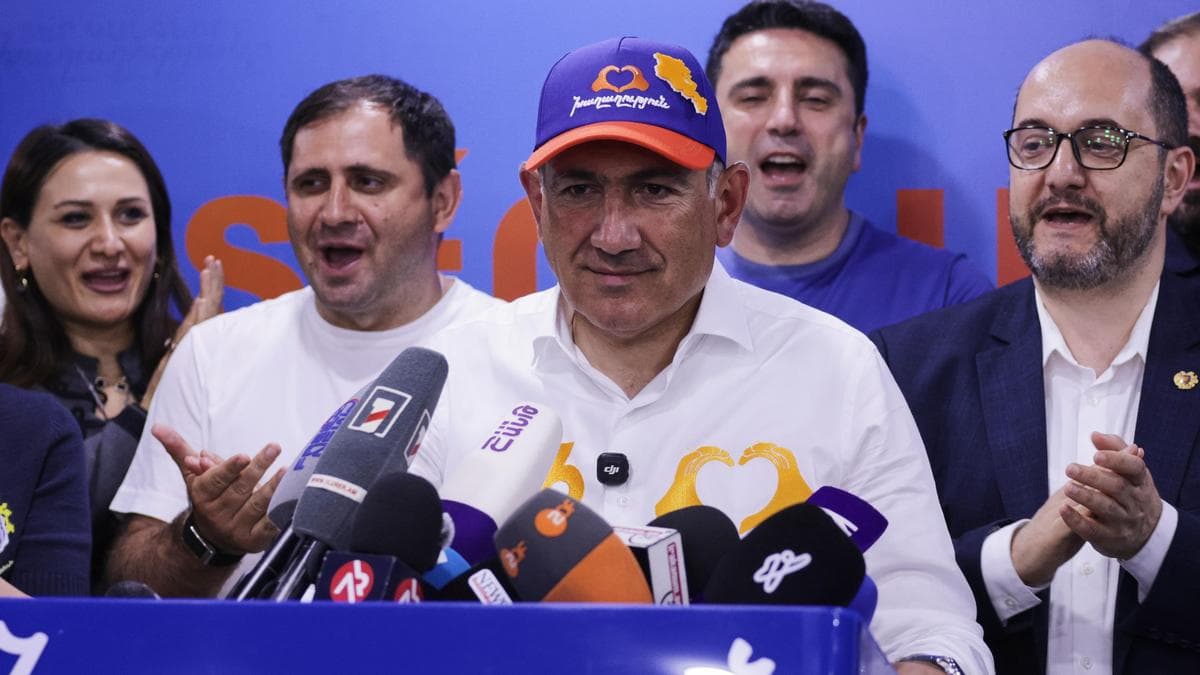
Prime Minister Nikol Pashinyan has secured a decisive victory in the June general election, signalling a clear shift in Armenia's geopolitical alignment away from Moscow.
The results from Sunday’s polls are in, and they paint a picture of a nation at a crossroads. As of Monday, June 8, 2026, Armenian PM Nikol Pashinyan has claimed victory, with preliminary counts placing his Civil Contract party at 49.82% of the vote. For Pashinyan, this isn't just another term; it is a mandate to pursue a radical reimagining of Armenia’s place in the world, one that involves distancing the country from its historical reliance on Russia and pivoting toward the European Union.
The election was, by all accounts, a referendum on the influence of Russia in the South Caucasus. Throughout the campaign, the air in Yerevan was thick with tension. While Pashinyan used the stump to advocate for democratic reforms and stronger Western ties, his primary challenger, the Russia-linked billionaire Samvel Karapetyan, took a starkly different line. Karapetyan’s "Strong Armenia" bloc—which secured 23.28% of the vote—accused the incumbent government of courting catastrophe by provoking the Kremlin.
The shadow of Moscow
The campaign was hardly a level playing field. Analysts have pointed to a barrage of Russian influence schemes and disinformation campaigns aimed at swaying the Armenian electorate. In the weeks leading up to the vote, the Kremlin applied economic pressure, hitting Armenian exports with restrictive measures. These tactics were accompanied by thinly veiled warnings from Vladimir Putin, with Russian officials drawing ominous parallels between Armenia’s current trajectory and the path taken by Ukraine prior to the 2022 invasion.
Despite this, the Armenian public has opted for a course of diversification. Pashinyan’s rhetoric remained consistent throughout the voting process, framing the European Union as the primary partner for the country’s future democratic and rule-of-law framework. His administration now holds the momentum to deepen security partnerships beyond the traditional Russian-led sphere.
Why it matters
This shift represents a significant geopolitical recalibration. For years, Armenia remained anchored to Moscow by security treaties and economic dependence. By winning this election, Pashinyan is signaling that the status quo is no longer tenable for a population increasingly looking toward Brussels for stability. However, the path ahead is fraught with risk; the Kremlin rarely takes such regional pivots lightly.
The next few days will be critical. While the Central Election Commission has tallied the ballots, the official results remain pending until Sunday to allow for the processing of any complaints regarding electoral irregularities. With political opponents like Karapetyan already crying foul—and facing their own legal battles for alleged insurrection—the domestic stability of Armenia will be tested as heavily as its foreign policy.
Politics Desk at PoliticalPedia covers parties & elections for an Indian audience in English and Hindi.