A Splash of Pride: Chennai’s New Mural Reclaims Space for Queer Joy
A mural in Chennai celebrates the ‘everydayness’ of queer life
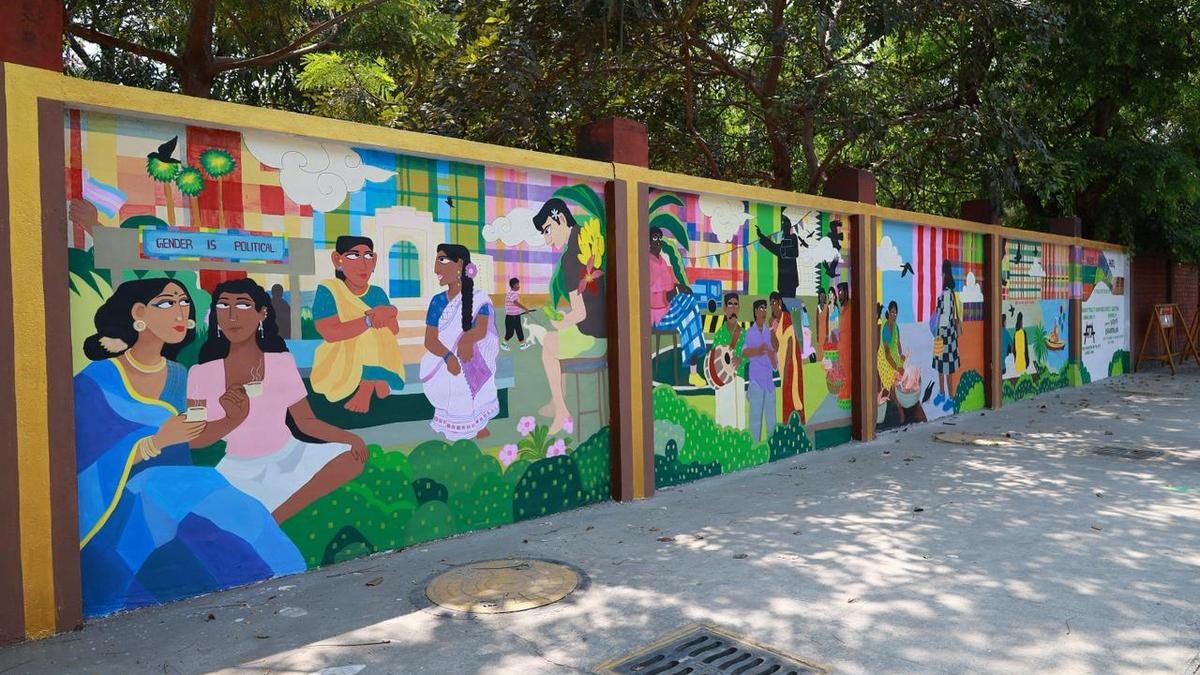
Beyond the annual parade, a vibrant new public installation near Anna University normalises queer identity through the lens of everyday life.
The wall outside the Kotturpuram gate of Anna University is no longer just a stretch of concrete. It is a riot of colour, a carefully curated canvas where the city’s skyline meets the intricate, familiar patterns of Madras textiles. Over five days, members of the Aravani Art Project and the Anonymous Art Collective—alongside a dedicated team of queer volunteers—transformed this public space into a bold, permanent fixture of Chennai’s cultural landscape.
Commissioned by the Avtar Foundation of Arts and supported by the office of South Chennai MP Thamizhachi Thangapandian, the project deliberately avoids the tropes often associated with queer representation. There is no performative edge here; instead, the mural focuses on the "everydayness" of the community. From the faces painted in the palette of the pride flag to the quiet scenes of domesticity, the artwork aims to dismantle the hyper-sexualised or "perverse" caricatures that often plague public discourse.
Taking Space, Claiming Identity
For the artists involved, the mural is an act of defiance against invisibility. Ghana, an artist with the Aravani Art Project, puts it simply: the goal was to show that queer people are, first and foremost, ordinary people. By taking up space in a high-traffic area of the city, the community is asserting its right to exist in the mainstream. It is a loud, unapologetic presence that moves beyond the temporary nature of an annual pride march.
Kanchana, a trans woman and artist on the project, describes the process as a rare, communal experience. While pride parades are high-energy, fleeting moments of visibility, the weeks spent painting this mural offered a sustained sense of belonging. "I’ve never done queer art like this in Chennai," she says, noting that this was a fully collaborative effort driven by the community itself, rather than an external entity looking in.
Why It Matters
This installation is a significant shift in how urban spaces in India engage with marginalised identities. For too long, equality has been treated as a legal pursuit—something to be fought for in courtrooms or parliament. By physically manifesting these identities on the streets of Chennai, the mural pushes the conversation from constitutional rights into the public square. It suggests that true integration isn't just about legislation; it’s about neighbourhoods and city walls becoming comfortable with diversity.
The involvement of elected officials in commissioning such work is also telling. It signals a move toward public infrastructure that reflects the actual demographic mosaic of the city. When a public wall tells a story of inclusion, it subtly alters the local environment, making it harder to dismiss queer lives as "fringe" or "other." This isn't just paint on a wall; it is the physical codification of a changing social contract in one of India’s most conservative yet evolving metros.
Kabir Sharma writes on culture, technology and everyday life for PoliticalPedia.