Jaipur Demolition Drive: Internet Suspended as Religious Structures Razed for Road Expansion
Jaipur anti-encrochment drive: Mosque demolished to widen road; 2 temples, mazaar to be taken down
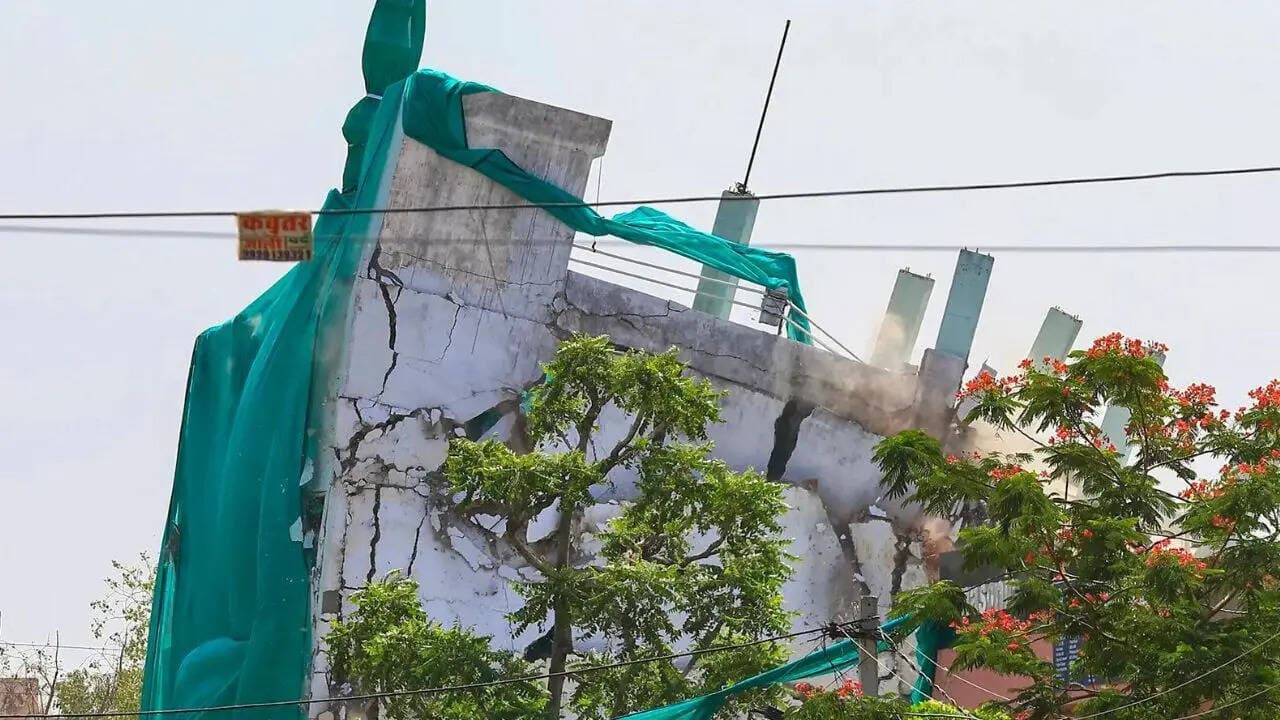
Authorities have deployed 3,000 police personnel and disconnected mobile internet across parts of Jaipur to clear a path for a long-pending 80-foot road expansion project.
The silence in the Jagatpura area of Jaipur on Monday was heavy, punctuated only by the low rumble of bulldozers and the presence of 3,000 police personnel. Under a blanket of strict security, the Jaipur Development Authority (JDA) launched a major anti-encroachment drive to clear a 1.5-kilometre stretch of land near the Nandpuri Underpass. The objective: to widen a narrow, congested road running parallel to the railway line to a sanctioned width of 80 feet.
To ensure the operation proceeded without incident, the district administration took the rare step of suspending mobile internet services—including 2G, 3G, 4G, and 5G—across Jaipur North and Jaipur East police districts. The ban, which extended to bulk SMS and social media platforms, was put in place from midnight on Sunday to midnight on Monday to prevent the spread of rumours and potential communal friction.
A Controversial Clearing
The demolition list includes five religious structures that fall within the road’s right-of-way: a mosque, two temples, a satsang bhavan, and a mazar. Officials maintain that these constructions were unauthorized encroachments blocking critical public infrastructure. According to JDA records, the road currently fluctuates between 25 and 30 feet in width, making it a persistent bottleneck for traffic in the south-eastern part of the city.
The administration stated that stakeholders were given ample time to remove the structures voluntarily before the heavy machinery arrived. With the deadline passed, the JDA moved forward with the excavation, supported by 12 companies of the Rajasthan Armed Constabulary. In addition to the internet shutdown, local power supplies were temporarily disconnected, and drone surveillance was deployed to monitor the area.
Why It Matters
This exercise highlights the recurring tension between urban planning and the sensitive nature of land use in Indian cities. When civic projects intersect with long-standing religious sites, the administration is often caught between the necessity of modernizing infrastructure and the risk of inflaming local sentiments.
The use of an internet blackout reflects a broader, albeit controversial, administrative strategy to manage law and order in an age where misinformation can travel faster than physical reinforcements. By preemptively restricting digital communication, the state is signalling a "zero-tolerance" approach to any potential unrest. However, the move also underscores the fragility of public peace in densely populated urban pockets, where even a road-widening project can turn into a high-security event requiring a massive police footprint.
The Path Ahead
Prohibitory orders under Section 163 of the Bharatiya Nagarik Suraksha Sanhita remain in effect until June 22. These orders strictly forbid unauthorized public meetings or processions in the affected areas. While the JDA continues to clear debris and push forward with the road project, the focus remains on whether this will set a precedent for other pending encroachment drives across the state capital. For now, the administration is focused on completion, while the residents of Jagatpura watch a familiar city landscape undergo a permanent, and for some, painful, transformation.
Features Desk at PoliticalPedia covers culture, tech & life for an Indian audience in English and Hindi.