Diplomatic Tensions Mount as Congress Corner Centre Over Deaths of Three Indian Sailors in US Strike
'US resorting to language of threats': Congress attacks Centre over death of 3 Indian sailors
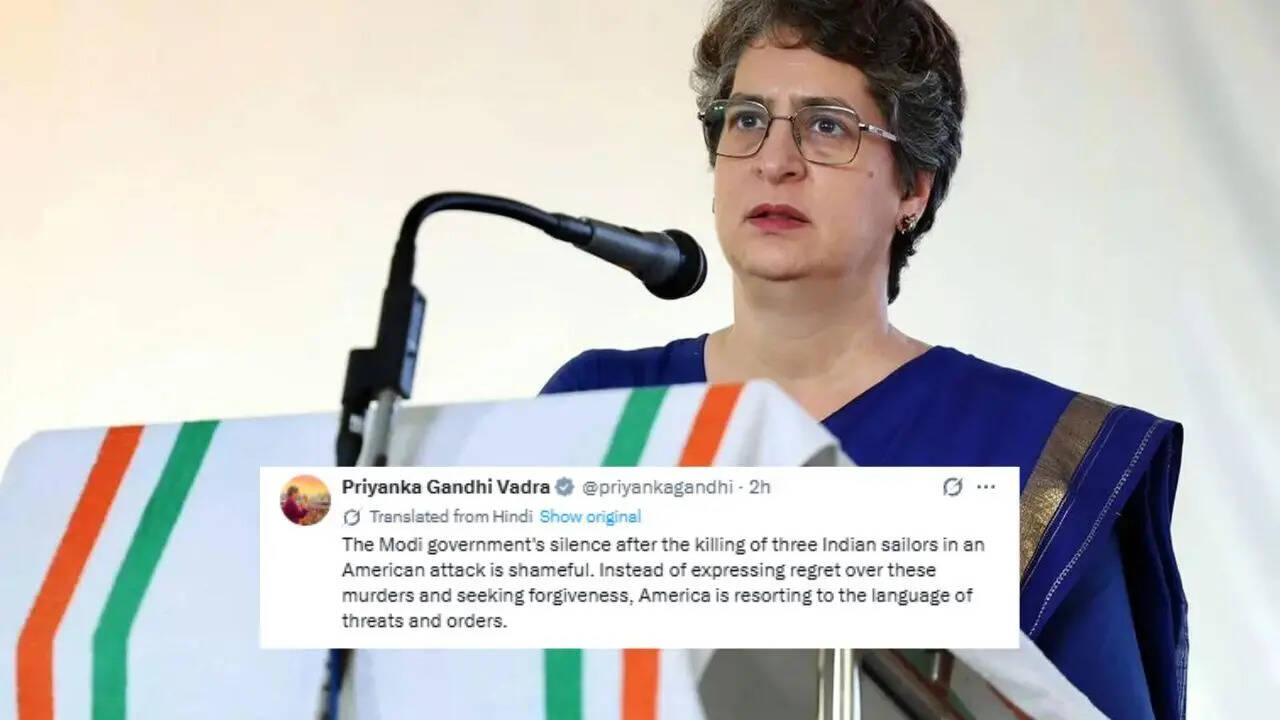
The deaths of three Indian crew members in a US military strike on a commercial tanker have ignited a fierce political standoff between the opposition and the Union government.
The silence from South Block has triggered a storm in the capital after a US military strike on the Palau-flagged tanker MT Settebello left three Indian sailors dead in the Gulf of Oman. As the vessel transited near the strategically vital Strait of Hormuz, it was targeted by American forces under the premise of enforcing a blockade against Iranian oil shipments. With 24 Indian crew members on board, the incident has quickly evolved from a maritime tragedy into a high-stakes diplomatic and domestic political crisis.
Congress leaders have wasted no time in mounting a direct offensive against the Centre. Priyanka Gandhi Vadra led the charge on Sunday, labeling the government’s initial response as "shameful." She argued that the Modi government must move beyond its restrained stance and demand a formal apology from the United States, asserting that India’s sovereignty is at stake when the lives of its citizens are treated with such apparent disregard.
A Clash of Narratives
The diplomatic friction is evident in the starkly different tones adopted by New Delhi and Washington. External Affairs Minister S Jaishankar has reportedly conveyed a "strong protest" to US Secretary of State Marco Rubio, describing the attack on a commercial vessel as unjustified. However, this move has been dismissed by the Congress as too little, too late. Party leader Pawan Khera questioned the government’s mild posture, pointing out that international law offers protection to commercial shipping even in conflict-prone zones.
The US State Department, meanwhile, has remained defiant. In a statement that has rankled many in the Indian political establishment, US officials maintained that all commercial vessels in the Strait of Hormuz must comply with American directives. By framing the strike as a necessary enforcement of its blockade, Washington has effectively signaled that it will not tolerate the transport of Iranian oil, regardless of the civilian casualties involved. Congress MP Manish Tewari has demanded that the government disclose the full details of the talks between Jaishankar and Rubio, accusing the US Secretary of State of showing a lack of empathy.
The Bigger Picture: Why it Matters
This incident highlights the precarious position India occupies as it attempts to balance its strategic partnership with the United States against its independent foreign policy interests. The deaths of these sailors are not merely a tragic maritime accident; they expose the limitations of India’s influence in regional conflicts where Western military interests collide with global trade routes.
For the government, the challenge is twofold: it must pacify a domestic opposition demanding a muscular assertion of national sovereignty while simultaneously preventing a permanent rift with a key global ally. The pattern here suggests a growing friction point, as New Delhi finds itself increasingly caught in the crossfire of US-Iran tensions. Moving forward, how the Centre manages the fallout will likely define its approach to protecting Indian nationals in volatile waters and whether it can extract accountability from its Western partners in the face of such aggressive military maneuvers.
Arjun Mehta reports on government, policy and Parliament for PoliticalPedia, in English and Hindi.