Beyond the Horizon: Why China’s KJ-3000 is Changing the Airborne Surveillance Game
China’s new 'eyes in sky': How KJ-3000 is building Beijing’s airborne surveillance edge
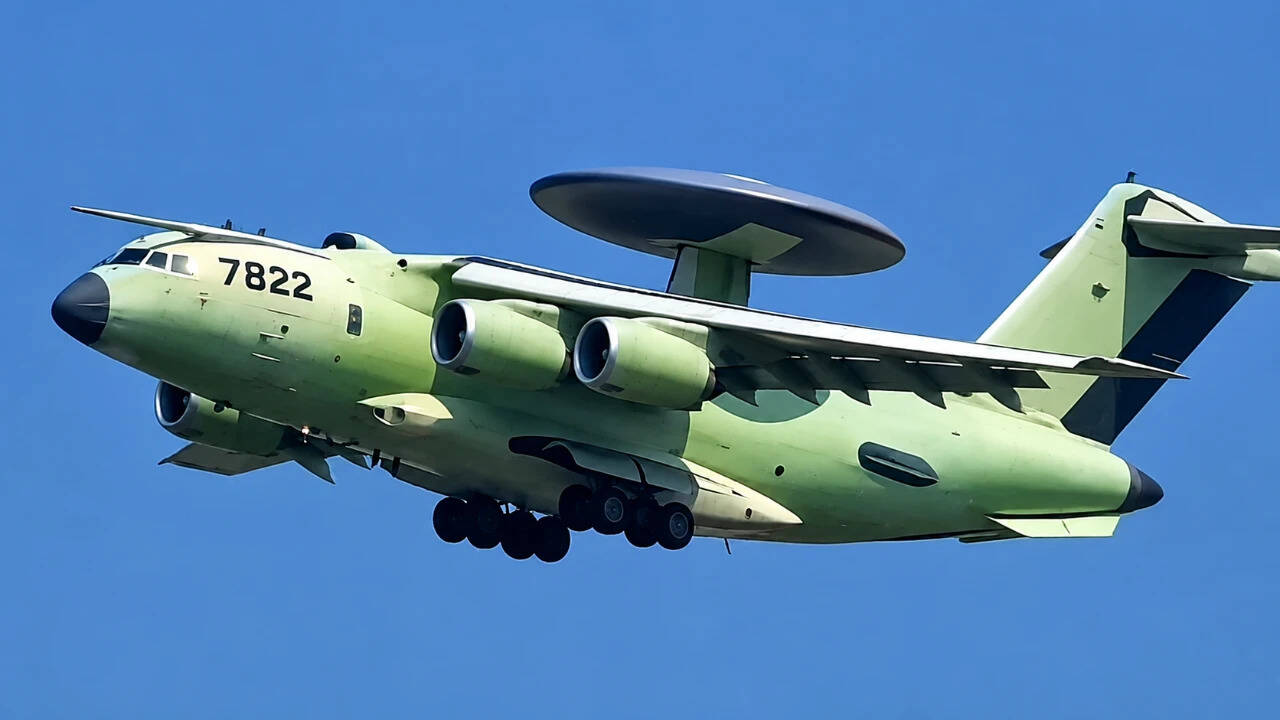
Beijing is scaling up its strategic reach with a new digital-radar heavy lifter that promises to rewrite the rules of aerial situational awareness.
The view from the cockpit is changing. Military planners watching satellite feeds of Chinese airfields have spotted something that is making waves across global security circles: the KJ-3000. While the world has grown accustomed to the KJ-500, this new arrival represents a significant leap in scale and ambition. Built on the frame of the Y-20B strategic transport aircraft, the KJ-3000 is not just a larger plane; it is a signal that Beijing is moving toward a more sophisticated, software-defined future for its airborne warning operations.
Powering the Watchtower
At the heart of this new platform is a shift in propulsion. The aircraft is powered by four WS-20 turbofan engines, each capable of generating approximately 138 kN of thrust. This is a noticeable upgrade from the Russian-made D-30 engines that pushed earlier Y-20 models. The efficiency of the WS-20 is not just about speed; it is about endurance. Airborne early warning (AEW&C) systems are essentially flying power plants. They need consistent, high-capacity energy to run massive radar arrays for extended periods while coordinating fighter jets across large, contested spaces.
The Digital Edge
The most intriguing aspect of the KJ-3000 is its reported architecture. According to Pentagon assessments, this could be the world’s first airborne early warning aircraft built entirely around a digital radar system. Traditionally, radar systems rely heavily on fixed hardware to process signals. By shifting this burden to software-driven systems, the KJ-3000 gains a vital edge: agility. A digital system is much harder to jam, allows for faster identification of targets, and—perhaps most importantly—can be upgraded with a simple code patch rather than an expensive hardware overhaul.
Why it matters
The rise of the KJ-3000 signals a broader trend in how regional powers are thinking about force multiplication. An early warning aircraft does not just "see" targets; it acts as the brain of an entire fleet, directing operations and expanding the range of ground-based defenses. By mounting a massive dorsal radome on a large-body frame, China is clearly aiming to project its "eyes in the sky" further than ever before. With passive detection capabilities that might allow the aircraft to track targets without revealing its own position, the KJ-3000 represents a shift toward stealthier, more resilient surveillance.
A Growing Fleet
This isn't an isolated development. Over the last two decades, China has steadily transitioned from a small, boutique force to a layered, deep inventory of surveillance aircraft. With two prototypes currently undergoing flight testing, the KJ-3000 is expected to eventually sit at the top of a food chain that already includes the reliable KJ-500. As these aircraft move from the hangar to the skies, they provide Beijing with an integrated view of multiple theaters, turning the vast expanse of the skies into a managed, highly visible battlefield.
Kabir Sharma writes on culture, technology and everyday life for PoliticalPedia.