Beyond the Classroom: Why the Ministry Announces National Poetry Festival for School Students
Ministry Announces National Poetry Festival 2026 For School Students: Check Details Here
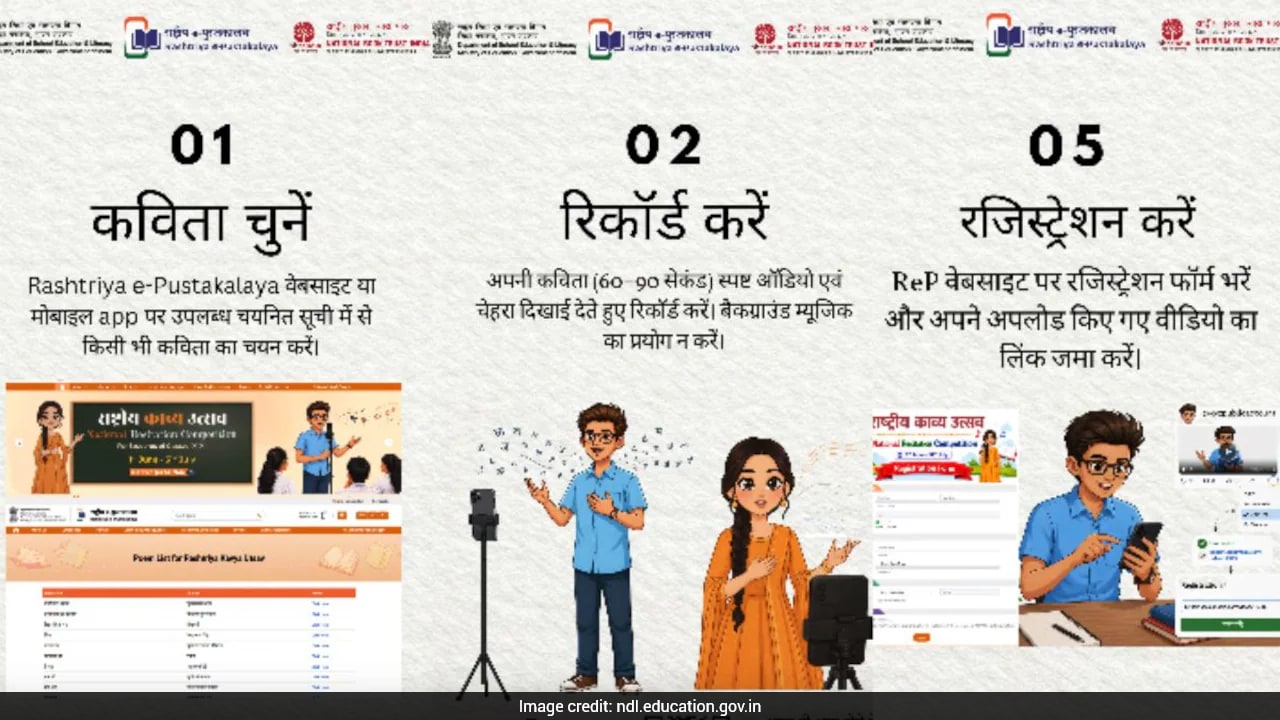
An opportunity for budding poets in Classes 9 to 12 to find their voice on a national stage through the Rashtriya e-Pustakalaya.
In an era dominated by short-form video and rapid-fire text, the rhythm of a well-crafted stanza often gets lost in the noise. To bridge this gap, the Ministry of Education has stepped in with a fresh initiative: the National Poetry Festival 2026. This isn't just another school competition; it is a deliberate nudge for students to move beyond textbooks and engage with the cadence of language.
How to participate
The festival, specifically designed for students in Classes 9 to 12, is now open for registration. To participate, students must head over to the official Rashtriya e-Pustakalaya (ReP) portal—the government’s digital library initiative—to select a poem from the provided list. Once a selection is made, the task is straightforward but requires precision: record a 60 to 90-second video of yourself reciting the piece.
There are a few ground rules to keep in mind before you hit record. The ministry has specified that the video must feature the student’s face clearly throughout the duration. Audio quality is paramount, and importantly, there should be no background music. Whether you choose to upload your entry through your own account or one managed by a parent or guardian, ensure the submission is completed by the July 31, 2026, deadline.
Why it matters
This festival is part of a broader push to integrate the Rashtriya e-Pustakalaya into the daily lives of Indian students. By tying a creative national platform to a digital repository, the ministry is attempting to transform how students perceive these platforms—shifting them from static storage sites into active spaces for literary performance.
For the students, the incentives go beyond the digital spotlight. The top 10 participants are set to receive a Certificate of Excellence, while all valid entries will be acknowledged with participation certificates. It is a low-stakes, high-visibility environment that encourages young people to explore public speaking and the emotive power of verse.
The bigger picture
The launch of this festival highlights a subtle shift in the education sector’s focus: moving toward "expression-based" learning. While board exams—like the recently declared UP and Uttarakhand Class 10 and 12 results—remain the primary metric for academic progress, initiatives like this provide a necessary counterweight. They suggest that the ministry is increasingly interested in extracurricular engagement that leverages digital infrastructure. As students balance their academic pressure with these creative outlets, the festival serves as a reminder that literacy in the 21st century is as much about performance and digital fluency as it is about written comprehension.
Kabir Sharma writes on culture, technology and everyday life for PoliticalPedia.