Ankara’s New Edge: The Kızılelma and the Changing Skies Over Asia
Türkiye’s next-gen unmanned fighter demonstrates precision strike capability
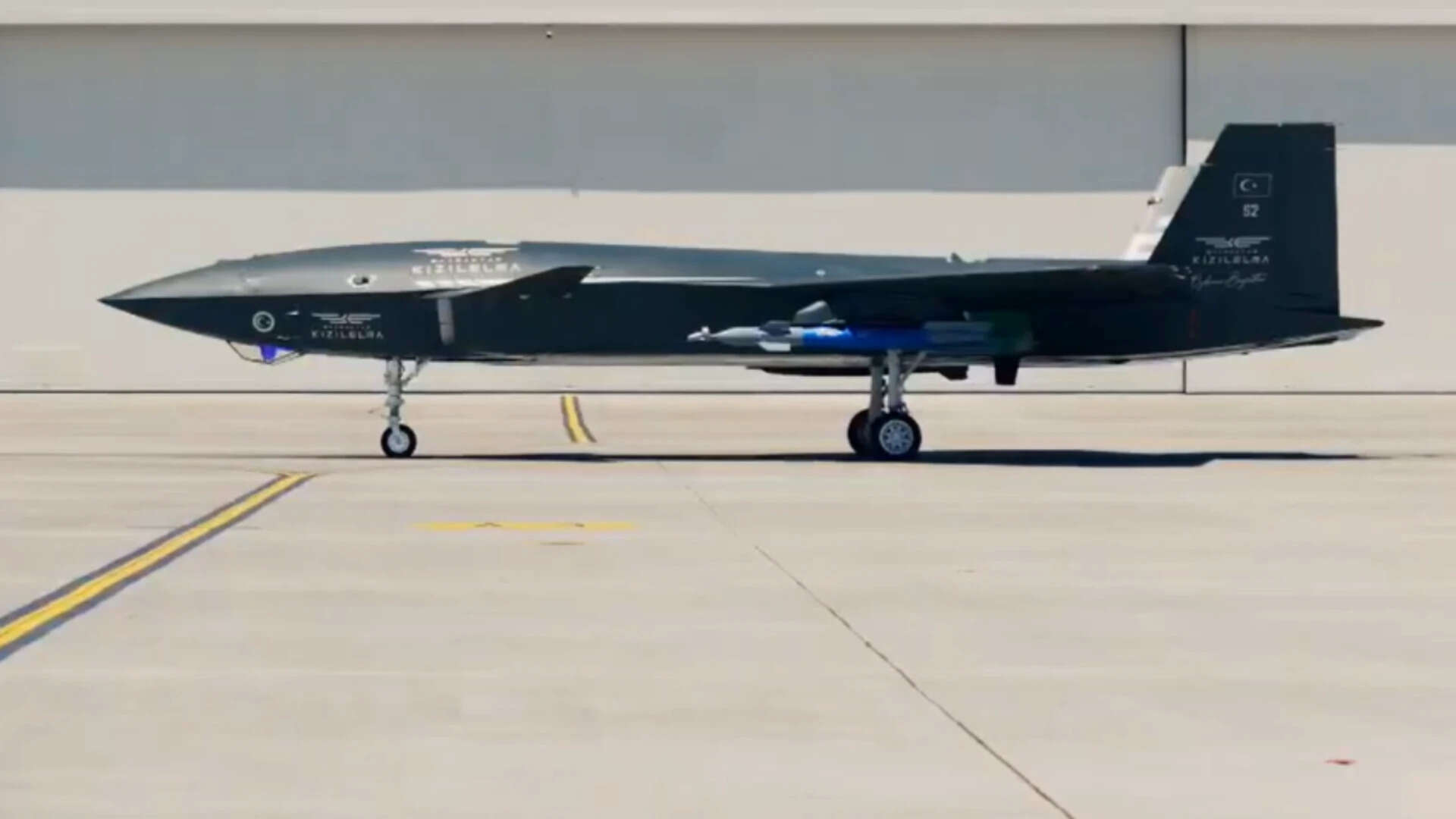
Türkiye’s unmanned fighter jet has successfully cleared precision-strike hurdles, signaling a shift in aerial warfare that New Delhi is watching closely.
The sound of the future is silent, jet-powered, and currently circling above the testing ranges of Türkiye. The Bayraktar Kızılelma, a sleek, stealthy unmanned fighter, has officially moved from a prototype dream to a functional reality, recently clearing live-fire tests using LGK-82 and TEBER-82 precision-guided munitions. By integrating Aselsan’s Electro-Optical Targeting System, the aircraft demonstrated an ability to track and designate targets with lethal accuracy—a leap that effectively bridges the gap between the small tactical drones that redefined conflicts in Ukraine and Nagorno-Karabakh and the traditional, human-piloted jets that have dominated combat for decades.
This development is more than just a technical milestone for the Turkish defence sector; it is a declaration of strategic independence. With a maximum take-off weight of six tonnes and a design optimized for both air-to-air and air-to-ground missions, the Kızılelma is engineered to act as a force multiplier. For a country that has spent years transforming its industry from a buyer to a powerhouse, this platform represents the endgame of a long-term investment in autonomous systems, moving beyond the TB2 and Akinci to secure a dominant position in the global security market.
The Regional Arms Race
The implications for Asia are immediate and palpable. Pakistan, which already maintains an extensive fleet of Turkish-made platforms—including the Anka and Akinci—has been expanding its defence relationship with Ankara. Reports suggest that the two nations are even exploring the establishment of a localized drone production line. Given that the Pakistan Air Force has a history of deploying Turkish unmanned systems, the potential induction of the Kızılelma into their inventory would fundamentally alter the deep-strike balance across the border.
New Delhi is not standing still, however. India has its own answer to the "loyal wingman" concept: the Combat Air Teaming System (CATS) program. Led by Hindustan Aeronautics Limited, the CATS Warrior is designed to fly in concert with manned fighters, utilizing AI-driven autonomy and GPS-independent navigation. As the regional race for autonomous airpower accelerates, both nations are essentially building a new layer of aerial warfare where the pilot is no longer just a driver, but a commander of an invisible, robotic fleet.
Why it matters
The rise of platforms like the Kızılelma points to a permanent shift in how middle-tier powers project influence. We are entering an era where airpower is no longer tethered to the high cost and political sensitivity of risking human lives in the cockpit. By mastering autonomous, jet-powered strike capabilities, Ankara is providing a blueprint for nations seeking "airpower without dependence" on traditional superpowers.
However, this transition brings new risks. As these systems become more affordable and widespread, the threshold for entering a conflict lowers, and the speed of escalation increases. The challenge for regional security in Asia will not just be keeping pace with the technology, but managing the stability of a neighborhood where the next air strike might be launched by an algorithm rather than a human hand.
Ananya Iyer covers global affairs with an Indian lens for PoliticalPedia.